
Why Tire Dressing Slings Off (and How UV Protectants Actually Work)
Quick Answer
Tire dressing slings off because the polymer film has not bonded or cured before the wheel rotates — almost always a result of over-application combined with driving too soon, not a defect in the product. Apply thin and even, and allow 10 to 30 minutes of dwell before highway speed.
UV protectants work by adding UV absorbers, antioxidants, and HALS (hindered amine light stabilizers) on top of the rubber compound — supplementing the antiozonants and stabilizers compounded into the tire at the factory. Bottle thickening or separation in storage is normal polymer settling and disperses with shaking.
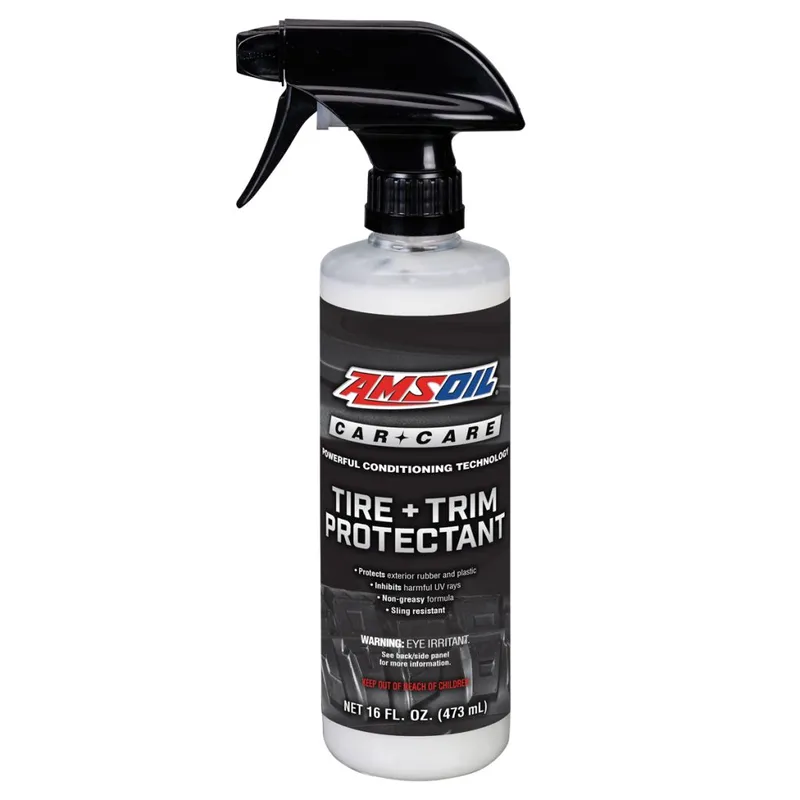
The product discussed here is AMSOIL Tire and Trim Protectant; the rest of this article walks through the rubber chemistry, the polymer film, and the physics of sling-off.
Tire and trim products attract more bad chemistry myths than any other category in car care. Some of the myths are harmless (“dressing makes tires fail” — generally not true for modern formulations). Some lead to bad habits (over-applying, then complaining about sling-off). Almost all of them stem from a misunderstanding of what these products are actually engineered to do.
The visible benefit is gloss. The actual job is UV and ozone protection of a polymer that, left untreated, degrades measurably year over year. This article walks through the materials science of rubber, the polymer chemistry of dressings, the physics of sling-off, and the real reasons a good protectant behaves the way it does in the bottle. It is part of a four-article series on car care chemistry; the hub article covers the broader formulation picture.
What rubber actually is
A passenger tire sidewall is not “just rubber.” It is a vulcanized polymer composite — typically a blend of natural rubber, styrene-butadiene rubber (SBR), polybutadiene, and butyl — crosslinked with sulfur and reinforced with carbon black, silica, and various process oils. Antiozonants, antioxidants, and UV stabilizers are compounded in during manufacture. Rodgers’ Rubber Compounding: Chemistry and Applications (CRC Press, 2nd ed., 2016) is the working reference; Polymer Degradation and Stability (Elsevier) is the primary peer-reviewed venue for ongoing degradation research.
Three degradation mechanisms drive sidewall aging:
- UV-induced chain scission. UV-A and UV-B photons break C-C and C=C bonds in the polymer backbone. ASTM G154 (UV exposure) and SAE J2412 / J2527 (xenon-arc weathering) are the standard accelerated tests.
- Ozone attack. Atmospheric ozone preferentially reacts with C=C bonds in unsaturated rubber. The result is surface crazing — fine cracks running perpendicular to applied stress. ASTM D1149 specifies the standard ozone-resistance test.
- Thermal oxidation. Elevated temperature accelerates oxidation of the polymer network. ASTM D573 specifies the standard heat-aging test.
Every one of these mechanisms is a chemistry problem with a chemistry solution. Antioxidants (typically phenolic and amine types) intercept oxidation. UV absorbers (benzotriazoles, benzophenones) absorb harmful wavelengths and dissipate the energy as heat. Hindered amine light stabilizers (HALS) interrupt the radical chain reactions that propagate UV damage. The compounds work in combination; the degradation kinetics are well-described in the Polymer Degradation literature.
A tire is born with these stabilizers compounded in. A protectant is the topical refresh layer that supplements them.
Antiozonants and the 6PPD note
The most common antiozonant in tire compounding has historically been 6PPD (N-(1,3-dimethylbutyl)-N′-phenyl-p-phenylenediamine). It is highly effective at protecting rubber from ozone attack. It is also at the center of an active environmental-chemistry concern: 6PPD-quinone, an oxidation product, has been implicated in coho salmon mortality from stormwater runoff (USGS and EPA research, peer-reviewed work in Environmental Science and Technology).
Topical tire protectants do not generally contain 6PPD; they rely on different stabilizer chemistries (UV absorbers, HALS, and antioxidants compatible with topical application). The point is worth knowing: rubber chemistry is a live research area, not a finished story.
What a protectant actually does
A topical tire and trim protectant has three jobs, in priority order:
- Add UV absorber and antioxidant chemistry to the surface to supplement what the polymer was compounded with from the factory.
- Form a thin polymer film that fills micro-cracks and reduces surface area exposed to ozone.
- Provide a cosmetic appearance — the gloss that drives most consumer choice.
Notice that gloss is third on the list. A protectant tuned only for gloss will leave UV protection on the table; a protectant tuned only for UV will look matte and dry. The formulator has to do both.
Water-based vs. silicone vs. hybrid
Three formulation families dominate the category:
- Water-based emulsions. Polymer particles dispersed in water with surfactants. Easy to apply, low VOC, generally lower gloss, lower sling-off when properly applied, shorter durability. Cleanup is forgiving.
- Solvent-based silicone. Silicone oils carried in petroleum solvents. Highest gloss, longest visual durability, highest sling-off risk if over-applied, more aggressive on certain plastics. Largely displaced by water-based and hybrid systems in passenger automotive.
- Hybrid polymer systems. Combined silicone and acrylic or polyurethane polymer chemistry, often as a water-based emulsion. The aim is silicone-level gloss with water-based ease of application. Most modern premium dressings sit here.
The choice is rarely about which family is “best” in isolation; it is about which family fits the user’s tolerance for sling-off vs. dressing frequency.
Why sling-off happens
A loaded tire at 60 mph experiences significant rotational shear at the sidewall surface. Any product that has not bonded or dried before that shear is applied will be flung outward by centrifugal force. The trajectory carries it onto the lower body panels, rocker panels, and quarter panels — exactly where it is most visible.
Three variables drive sling-off:
- Polymer molecular weight and surface adhesion. Higher-MW polymers form a tougher, more adherent film but are harder to disperse evenly. Lower-MW polymers level easily and sling more readily.
- Application thickness. Thick application leaves polymer that has not cured before the vehicle moves. Sling-off scales nonlinearly with thickness — a panel-load over-application can throw far more product than an even, thin application of the same total volume.
- Cure time before driving. Most water-based dressings need 10 to 30 minutes of dwell before highway speeds. Driving immediately after application is the largest single cause of sling-off complaints.
The defense is technique, not chemistry. A thin, even application with adequate dwell will not sling, regardless of which family the product comes from.
Why protectants thicken or separate in the bottle
This is the most common “is this product defective?” question in the category. The answer is in Stokes law: a particle suspended in a fluid settles at a rate proportional to the square of its radius and the density difference between particle and fluid, divided by the viscosity. Larger, denser particles settle faster.
A modern hybrid dressing suspends polymer particles in a water-based or hybrid carrier. Over months in storage, the polymer migrates downward and the carrier accumulates at the top. The product looks separated. It is not failed — it is doing exactly what physical chemistry predicts.
Shaking redisperses the polymer. A well-formulated product redisperses in 15 to 30 seconds of vigorous shaking; a poorly formulated one does not. Thickening on storage is, in this category, a sign the product contains real polymer chemistry rather than a thin solvent solution. Products that never thicken often contain less of the polymer that drives durability and protection.
Trim plastics: a different problem
Tires get the headline; exterior trim is the harder target. Most modern exterior trim is polypropylene (PP), thermoplastic olefin (TPO), or polycarbonate-acrylonitrile butadiene styrene blend (PC-ABS), often with talc or glass fiber reinforcement. These plastics oxidize on the surface under UV exposure, lose their plasticizer or low-MW additives, and fade to gray.
A tire and trim product addresses both:
- Penetration. Carriers and conditioners penetrate the porous oxidized layer of the trim plastic.
- Surface film. A polymer layer fills surface roughness and restores visual depth.
- UV protection. The same UV absorber and HALS chemistry that protects rubber works on the trim polymer.
For a deeply oxidized trim piece, a topical protectant restores appearance temporarily. Permanent restoration usually requires a dedicated trim-restorer product that uses heat or chemical bonding to deposit a more durable film. The protectant role is maintenance, not restoration.
What an engineered tire and trim product looks like
A protectant doing the chemistry described above will typically include:
- A polymer system (silicone, acrylic, polyurethane, or a hybrid) tuned for film formation and adhesion.
- UV absorbers (benzotriazole or benzophenone class).
- HALS for radical scavenging.
- Antioxidants (phenolic and amine).
- A water-based emulsion carrier with surfactant stabilizers, or a low-aromatic solvent system.
- A leveling agent to ensure uniform film deposition.
- A defoamer for application-friendly behavior.
AMSOIL Tire and Trim Protectant is built on this chemistry. Its tendency to thicken in the bottle is a direct consequence of the polymer system it carries; shaking restores the dispersion.
Product Code: TTPCN-EA
Join the Preferred Customer program to save approximately 25% off the retail price
National Synthetics is an authorized AMSOIL dealer. Links earn us a commission at no extra cost to you. Full disclosure
Application notes that follow from the chemistry
- Clean before dressing. A wheel and tire cleaner removes brake dust, road grime, and any old dressing residue before reapplication. A new film bonds to a clean substrate, not to old dressing breaking down underneath.
- Apply thin and even. Two thin coats are better than one thick coat. The second coat goes on after the first has flashed off.
- Allow dwell before driving. 10–30 minutes for water-based; check the product label.
- Use a foam applicator, not a spray-only application on tires. Direct spray can land on disc rotors and brake components, where it is unwanted.
- Treat tires and trim as the same step. The same product addresses both substrates with the same UV chemistry.
Where to go from here
The chemistry of the wash that comes before dressing is in How pH-Balanced Car Shampoo Protects Paint and Coatings. The chemistry of paint protection sprays is in SiO2 Ceramic Spray Coatings Explained. The companion article on interior detailing chemistry closes out the cluster, and the hub article ties them together.
Frequently Asked Questions
Why does tire dressing sling onto my paint?
Sling-off happens when the polymer film at the tire surface has not bonded enough or has not dried enough before the wheel rotates. Rotational shear at highway speeds can throw any loose product off the tire shoulder. Application technique — thin, even, and a short cure time before driving — is the dominant variable, followed by the polymer molecular weight and adhesion characteristics of the product itself.
Is silicone bad for tires?
The concern is misplaced for high-quality automotive silicone formulations. The historical warning came from cheap solvent-based silicone dressings that contained solvents harmful to rubber over repeated use. Modern water-based silicone emulsions and hybrid polymer dressings are formulated for compatibility with passenger tire compounds.
Why does my tire dressing thicken or separate in the bottle?
Polymer settling is a normal consequence of suspending high-molecular-weight polymers in a low-viscosity carrier. Stokes law predicts the settling rate. A well-formulated product redisperses with shaking; if it does not, the product has aged out. Thickening is a sign the product is doing real polymer chemistry, not a sign of defect.
How often should I reapply tire dressing?
For a daily driver, every two to four wash cycles is typical. The polymer film wears with road exposure, washing, and UV. Trim plastic generally needs less frequent reapplication than tire sidewalls because trim is not exposed to as much mechanical wear.
Will tire dressing prevent sidewall cracking?
Cracking on rubber sidewalls comes from oxidation, ozone attack, and UV degradation over years of exposure. A protectant with UV absorbers and antioxidants slows these mechanisms but does not stop them. Sun exposure and storage conditions remain the largest variables.
References
- Rodgers, B. (ed.). Rubber Compounding: Chemistry and Applications. 2nd ed., CRC Press, 2016.
- Polymer Degradation and Stability (Elsevier), peer-reviewed literature on rubber and polyolefin degradation.
- Environmental Science and Technology (ACS), peer-reviewed work on 6PPD-quinone in stormwater.
- ASTM D573: Standard Test Method for Rubber — Deterioration in an Air Oven.
- ASTM D925: Standard Test Methods for Rubber Property — Staining of Surfaces.
- ASTM D1149: Standard Test Methods for Rubber Deterioration — Cracking in an Ozone Controlled Environment.
- ASTM G154: Standard Practice for Operating Fluorescent UV Lamp Apparatus for Exposure of Materials.
- SAE J2412: Accelerated Exposure of Automotive Interior Trim Components.
- SAE J2527: Performance-Based Standard for Accelerated Exposure of Automotive Exterior Materials.
- USGS and EPA research on 6PPD-quinone aquatic toxicity.
National Synthetics is operated by an Independent AMSOIL Dealer. Outbound product links use a dealer reference parameter; the technical content above is independent of that.

Protect Your Engine with AMSOIL
Experience the difference premium synthetic lubricants make. Shop with confidence through your authorized AMSOIL dealer.
Browse AMSOIL Products