
How pH-Balanced Car Shampoo Protects Paint and Coatings
Quick Answer
A pH-balanced (near-neutral, roughly pH 6 to 8) car shampoo cleans the surface without accelerating the hydrolysis reaction that breaks down SiO2 ceramic coatings, sealants, and modern OEM clearcoats.
Highly alkaline degreasers (pH above 11) clean fastest because they saponify oils, but they shorten coating life. A near-neutral surfactant blend with lubricity additives gives the same cleaning power on routine soils while preserving the protective layer and reducing wash-induced marring.
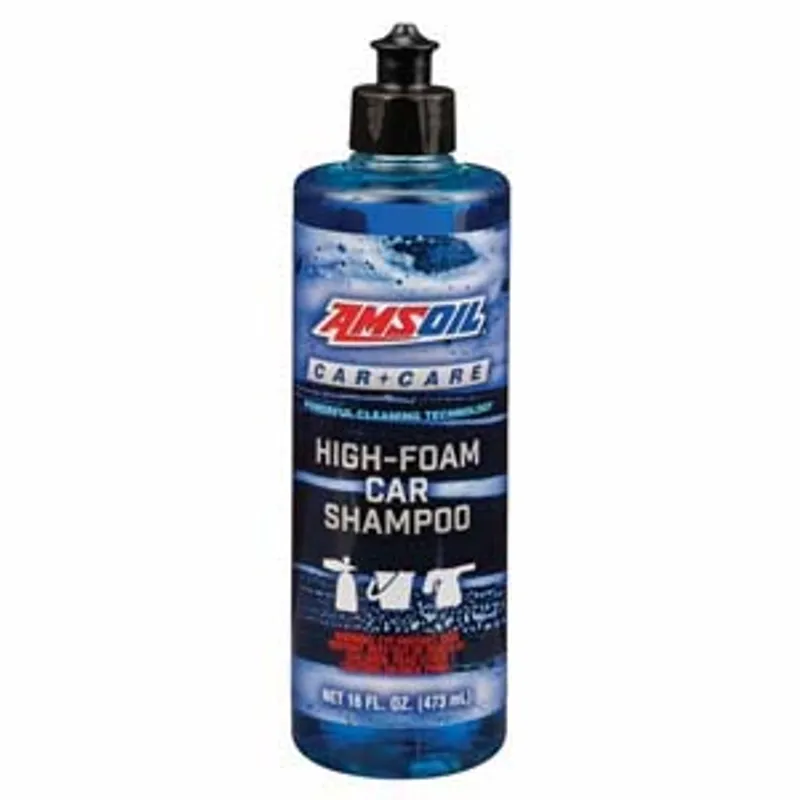
The product designed around this chemistry is AMSOIL High-Foam Car Shampoo; the rest of this article unpacks how the formula achieves it.
The shift from cheap dish-soap-derived car wash to pH-balanced, lubricity-enhanced shampoo is the single biggest formulation change in retail car care over the last decade. The reason is not marketing — it is the materials change in the surfaces being washed. Modern OEM clearcoats, factory and aftermarket SiO2 ceramic coatings, and graphene hybrid topcoats all have measurable pH tolerance windows, and aggressive degreasers fall outside those windows.
This article walks through the chemistry that drives that shift: what surfactants do, why pH matters, and why lubricity additives have become as important as cleaning agents. It is part of a four-article series on car care chemistry; the hub article covers the broader formulation picture.
What a surfactant actually is
A surfactant — short for surface active agent — is a molecule with a hydrophilic head and a hydrophobic tail. In water, surfactants migrate to interfaces (air/water, oil/water, water/paint) and reduce surface tension. Below a concentration called the critical micelle concentration (CMC), they behave as individual molecules. Above the CMC, they self-assemble into micelles — spherical aggregates with the hydrophobic tails inward and the hydrophilic heads outward — that surround and lift oils and particulate soils away from a surface.
The standard reference for this chemistry is Rosen and Kunjappu’s Surfactants and Interfacial Phenomena (Wiley, 4th ed., 2012). The standard test for surface tension is ASTM D1331.
Surfactants come in four broad classes by head-group charge:
- Anionic (negatively charged head): strong cleaners, high foam, the workhorses of laundry and dish detergents. Examples include sodium lauryl sulfate and linear alkylbenzene sulfonate.
- Nonionic (uncharged head): mild, low-foam, good at oil emulsification. Common in industrial cleaners and as co-surfactants in personal care.
- Cationic (positively charged head): typically used as antimicrobials and fabric softeners; rare in car wash chemistry because they can deposit residue on glass.
- Amphoteric (both charges, depending on pH): mild, skin-safe, common in shampoos for people. Increasingly used in coating-safe car shampoos.
Modern automotive car shampoos are usually built on a blend — most often anionics for cleaning power, nonionics or amphoterics for mildness and pH range, plus solubilizers, foam stabilizers, and lubricity polymers.
Why foam height is not cosmetic
ISO 696 specifies the standard test method for foam height. The reason a car shampoo formulator cares about foam stability is dwell time. Surfactants need contact time with the surface to penetrate, lift, and suspend soils. On a vertical body panel, foam that collapses immediately gives surfactants only seconds to do their work; a stable foam can extend that to minutes.
That is the mechanical reason foam-cannon-friendly shampoos became popular. The cannon deposits a thick foam layer at low panel impact velocity, which:
- Pre-soaks the panel before any wash media contacts it.
- Suspends loose particulate so it can be rinsed off rather than dragged across clearcoat.
- Provides extended dwell for the surfactant chemistry to lift bonded soils.
A formula tuned for high foam is a formula tuned for that workflow. It is not a formula tuned to clean better at the same dwell time.
The pH problem
This is the part that has driven the most formulation change. SiO2-based coatings — both factory clearcoats with silica modifiers and aftermarket ceramic coatings — degrade through a hydrolysis reaction in alkaline conditions. The Si-O-Si bonds in the coating network break in the presence of hydroxide ions; under neutral or mildly acidic conditions they are far more stable.
The practical implication: a wash chemistry above roughly pH 11 will measurably shorten the service life of a ceramic coating. Coating manufacturers (in OEM clearcoat documentation from PPG and BASF, and in aftermarket SiO2 coating technical data sheets) typically spec a near-neutral wash chemistry — generally pH 6 to 8 — for routine maintenance.
That is why “pH balanced” is not a marketing phrase on a modern car shampoo label; it is a compatibility specification.
There is a corollary: highly acidic wash chemistry has its own problems. Below roughly pH 4, anodized trim, polished aluminum, and bare metal threaten to etch. Acidic wheel cleaners are deliberately segregated as a different product class for that reason.
Lubricity and wash-induced marring
The dominant cause of swirl marks and fine scratches in clearcoat is not the wash chemistry — it is the mechanical interaction between contaminated wash media and the paint surface. A grit particle trapped in a wash mitt at 1 N of normal force, dragged across clearcoat, will cut a micro-scratch regardless of how good the soap is. ASTM D7869 and the broader paint-defect literature in Progress in Organic Coatings document this mechanism.
The defense is twofold: physical (clean wash media, two-bucket method, grit guards, microfiber instead of cotton) and chemical (lubricity additives in the shampoo). Lubricity polymers — typically polyacrylate, polyethylene glycol, or modified silicone derivatives — reduce the coefficient of friction at the mitt/paint interface. The grit is still there; the polymer film makes it more likely to glide rather than score.
This is one of the clearer cases of a chemistry choice that protects the user from their own technique. A shampoo with a strong lubricity package will outperform a stronger detergent on a ceramic-coated daily driver, simply because the failure mode at scale is marring, not soiling.
What an engineered car shampoo looks like
Putting the pieces together, a coating-safe high-foam car shampoo built for modern surfaces will typically include:
- A primary anionic or amphoteric surfactant system tuned to neutral pH.
- A foam stabilizer (often a fatty alcohol or amine oxide) to extend dwell time.
- A lubricity polymer or modified silicone to reduce mitt friction.
- A hydrotrope or solubilizer to keep the formula clear and shelf-stable.
- A chelating agent (often citrate or EDTA-alternative) to handle hard-water cations that would otherwise spot.
Each ingredient is chosen against compatibility constraints. For example, anionic surfactants and cationic conditioners cannot share a formula — they neutralize each other. Foam stabilizers chosen for warm-climate use behave differently in cold water. Lubricity polymers that work well at low concentrations may streak at higher ones.
That set of choices is the actual engineering work. AMSOIL High-Foam Car Shampoo is built around a near-neutral surfactant system with a lubricity additive package; the rationale is the chemistry described above.
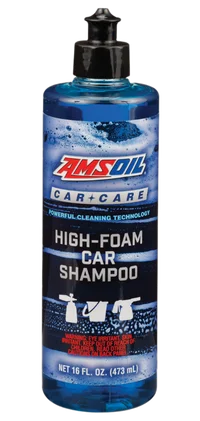
Product Code: HFBCN-EA
Join the Preferred Customer program to save approximately 25% off the retail price
National Synthetics is an authorized AMSOIL dealer. Links earn us a commission at no extra cost to you. Full disclosure
Practical implications
A few decisions follow naturally from the chemistry:
- Pick wash chemistry based on the coating, not the marketing. If the vehicle has a ceramic coating, near-neutral pH is non-negotiable. Save high-alkaline chemistry for engine bays and traffic-film decontamination on uncoated paint.
- Replace the wash media before the shampoo. Lubricity additives delay marring; they do not eliminate it. A clean, low-pile microfiber mitt is the bigger lever.
- Treat foam as a workflow tool, not a quality signal. Stable foam helps the foam-cannon and two-bucket workflows; it is irrelevant to a rinseless wash.
- Decontaminate periodically with the right chemistry. Iron removers (for brake-dust contamination) and clay-bar work belong in a separate maintenance pass, not in the routine wash.
For the broader picture of how shampoo chemistry interacts with coatings and dressings across the rest of the line, the hub article covers the full set of tradeoffs. For the specific chemistry of the spray-on protection that often follows a wash, see SiO2 Ceramic Spray Coatings Explained. The companion articles on tire and trim chemistry and interior detailing round out the cluster.
Frequently Asked Questions
Will dish soap strip my ceramic coating?
Most household dish soaps are formulated with high-pH alkaline surfactants and degreasers because their job is cutting food oils. Repeated use on a ceramic-coated vehicle accelerates hydrolysis of the SiO2 network and shortens coating life. Use a near-neutral, dedicated automotive shampoo instead.
What pH range is safe for ceramic-coated paint?
Coating manufacturers typically spec a near-neutral wash chemistry, generally in the pH 6 to 8 range, for routine maintenance. Highly alkaline (pH > 11) or strongly acidic (pH < 4) products are reserved for targeted decontamination steps with rinse and neutralization protocols.
Does foam height equal cleaning power?
No. Foam volume is a visual proxy for foam stability, which extends contact dwell time. The actual cleaning work is done by surfactants reducing surface tension and lifting soils into micelles. A high-foam shampoo with weak surfactants will not outclean a low-foam shampoo with the right surfactant blend, but a stable foam helps the chemistry work for longer before rinse.
What are lubricity agents and why do they matter?
Lubricity agents are additives that lower the coefficient of friction at the wash media / paint interface. They reduce the chance of trapped grit being dragged across clearcoat, which is the dominant source of wash-induced marring and swirl marks. ASTM D7869 and related test programs are the basis for understanding how these defects form.
Two-bucket wash, foam cannon, or rinseless — what does the chemistry favor?
A high-foam, near-neutral surfactant system with lubricity additives works well in all three workflows. The foam cannon gets the most benefit from foam stability. The two-bucket method gets the most benefit from lubricity. Rinseless wash chemistry adds polymers that encapsulate dirt and is a different formulation category.
References
- Rosen, M. J., and Kunjappu, J. T. Surfactants and Interfacial Phenomena. 4th ed., Wiley, 2012.
- ASTM D1331: Standard Test Methods for Surface and Interfacial Tension of Solutions of Paints, Solvents, Solutions of Surface-Active Agents, and Related Materials.
- ISO 696: Surface active agents — Measurement of foaming power — Modified Ross-Miles method.
- ASTM D7869: Standard Practice for Xenon Arc Exposure Test with Enhanced Light and Water Exposure for Transportation Coatings.
- Progress in Organic Coatings (Elsevier), peer-reviewed literature on automotive clearcoat defect formation.
- PPG and BASF OEM clearcoat technical data — pH tolerance ranges for refinish and OEM systems.
National Synthetics is operated by an Independent AMSOIL Dealer. Product links include a dealer reference parameter for commission tracking; the technical content above is independent of that.

Protect Your Engine with AMSOIL
Experience the difference premium synthetic lubricants make. Shop with confidence through your authorized AMSOIL dealer.
Browse AMSOIL Products