
SiO2 Ceramic Spray Coatings Explained: Chemistry and Durability
Quick Answer
SiO2 ceramic sprays use silane or siloxane precursors that hydrolyze on contact with surface moisture and condense into a thin, hard, hydrophobic Si-O-Si film. They typically last three to twelve months on a regularly washed daily driver.
Service life is driven by film thickness, crosslink density, UV exposure, and wash chemistry — not by the number on the bottle. Spray-on SiO2 is a different tool than a multi-thousand-dollar professional ceramic coating; it is also an excellent topper above one.
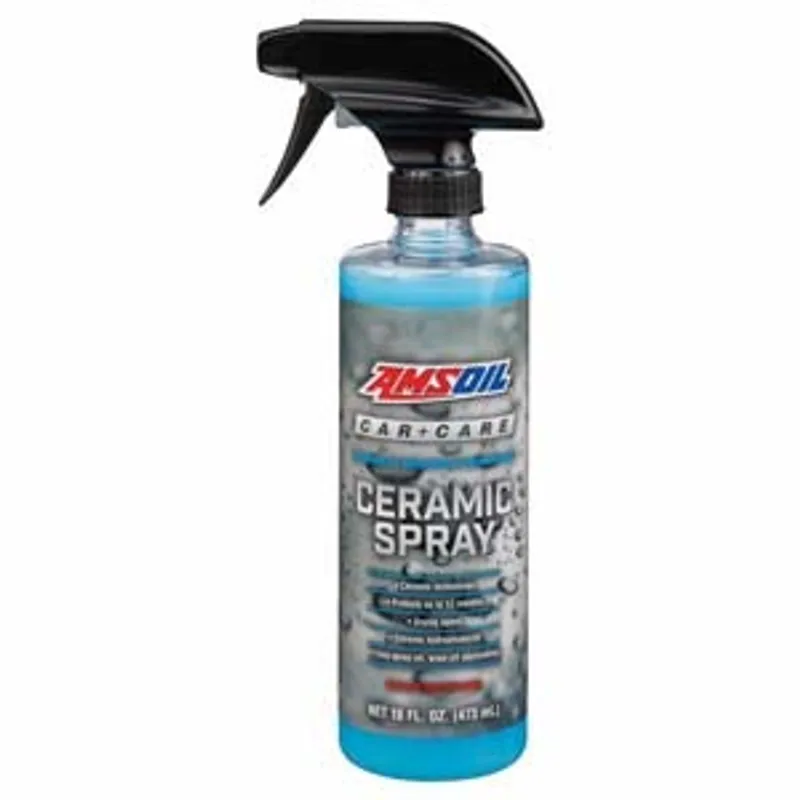
The spray-on chemistry discussed here is AMSOIL Exterior Ceramic Spray; the rest of this article explains how it bonds and what determines durability.
The “ceramic” category in retail car care is one of the most marketing-distorted spaces in the industry. The word covers everything from $20 spray bottles to $2,000 professional applications, and a lot of consumers walk away unsure whether they bought something real.
The chemistry, fortunately, is well-described in the materials science literature. This article unpacks what SiO2 ceramic sprays actually are, how they bond to paint, what determines their service life, and where they fit relative to spray sealants and professional ceramic coatings. It is part of a four-article series on car care chemistry; the hub article gives the broader context.
The terminology problem
A surprising amount of confusion is just vocabulary:
- Silica — silicon dioxide, SiO2. The mineral form is quartz.
- Silicone — synthetic polymer with a Si-O-Si backbone and organic side groups (typically methyl). Silicones are the family that includes silicone caulk and silicone tire dressings.
- Silane — a silicon hydride or organofunctional silicon compound. Often used as a precursor or coupling agent.
- Siloxane — a class of compounds with Si-O-Si linkages. Polysiloxanes are silicones.
- Silazane — a Si-N-Si compound. Some pro-grade ceramic coatings use silazane chemistry; spray products generally do not.
A “SiO2 ceramic spray” is, in practice, a sol-gel system that uses silane or siloxane precursors to deposit a silica-rich crosslinked film. The word “ceramic” is technically correct in the sense that the cured film is a ceramic-organic hybrid, but it is not a kiln-fired ceramic.
How sol-gel chemistry works
The reference textbook is Brinker and Scherer’s Sol-Gel Science: The Physics and Chemistry of Sol-Gel Processing (Academic Press, 1990). The peer-reviewed venue for ongoing research is Progress in Organic Coatings (Elsevier).
The reaction sequence is:
- Hydrolysis. The silane precursor reacts with surface moisture: Si-OR + H2O → Si-OH + ROH. This converts alkoxy groups to silanols.
- Condensation. Adjacent silanols react: Si-OH + HO-Si → Si-O-Si + H2O. This is the crosslinking step that builds the network.
- Aging and densification. Over hours to days, residual silanols continue to react, crosslink density increases, and the film hardens.
The net product is a thin, transparent, glassy film with a Si-O-Si backbone. Depending on the precursor chemistry, the film may include organic side groups that contribute hydrophobicity and flexibility.
What hydrophobicity means and how it is measured
The visible signature of a working SiO2 spray is high water contact angle and pronounced beading. The standard test method is ASTM D7334. A clean uncoated clearcoat panel typically shows a contact angle in the 70–90° range. A fresh SiO2 spray pushes that to 100–110°. A pro coating can exceed 110° in some chemistries.
Two regimes are worth knowing:
- Wenzel regime. On a smooth hydrophobic surface, the contact angle is set by the surface chemistry alone. This is the dominant regime for car paint.
- Cassie-Baxter regime. On a textured hydrophobic surface (think lotus leaf), trapped air under the droplet drives super-hydrophobic behavior with contact angles above 150°. This regime is rare on automotive paint and is more relevant to specialty coatings.
The Young equation describes the equilibrium contact angle as a function of surface energies. The takeaway: a higher contact angle is a proxy for a more hydrophobic, lower-surface-energy film.
What determines service life
Three variables dominate:
- Film thickness and solids content. A spray product that deposits 0.1 µm of film cannot last as long as a pro coating that deposits 1–2 µm. Thicker film equals more sacrificial material to lose to UV degradation, mechanical wear, and wash chemistry.
- Crosslink density. A fully cured pro coating reaches a higher crosslink density because it cures longer and at controlled humidity. A spray cured ambient at typical garage humidity reaches a lower density. Lower crosslink density means faster degradation under UV.
- Maintenance. A coating washed weekly with high-alkaline detergent will not last as long as one washed monthly with a near-neutral, lubricity-rich shampoo (see How pH-Balanced Car Shampoo Protects Paint and Coatings for the chemistry).
Standard durability tests in the coatings literature include ASTM G154 (UV exposure), SAE J2527 / ASTM G155 (xenon-arc weathering), and ASTM D7491 (chemical resistance). A spec-sheet claim of “12 months durability” should reference one or more of these methods, not a vague “tested for a year.”
Where SiO2 sprays sit relative to other options
A useful way to think about the protection ladder:
| Class | Typical chemistry | Typical durability | Typical use case |
|---|---|---|---|
| Carnauba wax | Natural ester wax | 4 to 8 weeks | Show finish, deep warmth, frequent reapplication |
| Synthetic sealant | Polymer (often acrylic or urethane) | 2 to 6 months | Daily driver, easy application |
| SiO2 ceramic spray | Sol-gel silane / siloxane | 3 to 12 months | Daily driver, spray-on, topper for pro coating |
| Professional ceramic coating | Higher-solids silane / silazane | 2 to 5 years | Long-term protection, controlled application |
| Graphene-modified hybrid | Coating with graphene additive | 2 to 7 years | Premium pro application |
Spray SiO2 is not a replacement for a professional coating — it is a different tool. It is, however, an excellent topper above a pro coating, and the right choice for a vehicle that does not justify a four-figure detailing investment.
The formulation tradeoffs
Inside the bottle, a spray-on SiO2 product is solving four simultaneous problems:
- Stability in the bottle. Silanols are reactive. The precursor must be stabilized (typically by alcohol carriers and trace moisture control) so it does not crosslink in storage.
- Spreadability. The product must wet out paint cleanly, which means tuned surface tension via solvent and surfactant choice.
- Working time vs. cure time. Solvent flash-off rate is the single hardest variable. Too fast and the user can’t level the film; too slow and the film streaks or attracts dust before cure.
- Self-leveling. Polymer additives help the film flow into a uniform layer before cure.
This is the part where formulation work shows up. AMSOIL Exterior Ceramic Spray is built on this chemistry — a SiO2 sol-gel system with carrier and additive choices tuned for ambient-cure ease of use.
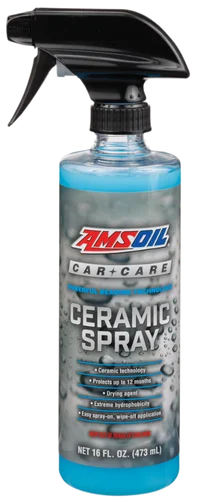
Product Code: CSFCN-EA
Join the Preferred Customer program to save approximately 25% off the retail price
National Synthetics is an authorized AMSOIL dealer. Links earn us a commission at no extra cost to you. Full disclosure
How to apply spray ceramics for best results
The chemistry implies a few application rules:
- Apply to a clean, decontaminated surface. Sol-gel films bond to silanol groups on the substrate. Wax, sealant residue, or contamination interferes with that bonding.
- Work in a shaded, cooler environment. Heat accelerates flash-off and shortens working time. Below 30 °C panel temperature is a reasonable target.
- Use small amounts per panel. Most streaking is over-application, not under-application. Two to three sprays per panel is typical.
- Wipe in two stages. A first pass to spread, a second clean microfiber pass to level.
- Allow cure time before exposure to water. Most spray ceramics call for one to two hours of cure before water contact, and 24 hours before a full wash.
A clean wash before application matters. A near-neutral shampoo (covered in the shampoo chemistry article) leaves the surface free of alkaline residue that would interfere with hydrolysis.
What spray ceramics will not do
Honest framing matters here:
- They will not fix swirl marks or scratches. Sol-gel films are too thin to fill defects. Paint correction with abrasive polish is a different process.
- They will not last for years. Twelve months is the optimistic upper bound for a spray product on a regularly washed vehicle. Anything beyond that is a pro coating.
- They will not survive aggressive chemical exposure. Iron removers, tar removers, and high-pH degreasers will all shorten service life. That is why decontamination is staged separately from routine wash.
- They will not protect against rock chips. Mechanical impact is outside the regime any spray product addresses.
Knowing what a product is not designed to do is most of the value of understanding the chemistry.
Where to go from here
The wash chemistry that protects a SiO2 film between applications is in How pH-Balanced Car Shampoo Protects Paint and Coatings. The companion articles on tire and trim UV chemistry and interior detailing chemistry cover the rest of the line. The hub article ties them together.
Frequently Asked Questions
What is SiO2 in ceramic spray, exactly?
SiO2 is silicon dioxide — silica. In a spray-on product, the active chemistry is usually a silane or siloxane precursor that hydrolyzes on contact with surface moisture and condenses into a crosslinked Si-O-Si network. The result is a thin, hard, hydrophobic film. The reference textbook is Brinker and Scherer, Sol-Gel Science (Academic Press, 1990).
How long does ceramic spray actually last?
Typical service life for a properly applied spray-on SiO2 product, on a regularly washed daily driver, is in the range of three to twelve months. Pro coatings target multiple years. Service life is driven by film thickness, crosslink density, UV exposure, and wash frequency and chemistry — not by the marketing claims on the bottle.
Does ceramic spray replace wax or sealant?
Functionally, yes — SiO2 sprays occupy the same step in a maintenance routine. Chemically they are different: wax is a soft, hydrophobic organic film; sealant is a synthetic polymer film; SiO2 spray is a thin sol-gel inorganic-organic hybrid film. Each has different durability and gloss characteristics.
Can I apply ceramic spray over a professional ceramic coating?
Yes — that is the most common use case for spray-on SiO2 products. They act as a topper that refreshes hydrophobicity and adds a sacrificial layer above the more expensive base coating. Application timing is typically every two to four months depending on use.
Why does ceramic spray streak?
Streaking comes from solvent flash-off rate and residual product. If the carrier solvents flash off too fast, the polymer levels poorly and dries before it can be wiped uniform. Working in cooler conditions, on a clean surface, with a small amount of product per panel, eliminates most streaking issues.
References
- Brinker, C. J., and Scherer, G. W. Sol-Gel Science: The Physics and Chemistry of Sol-Gel Processing. Academic Press, 1990.
- ASTM D7334: Standard Practice for Surface Wettability of Coatings, Substrates and Pigments by Advancing Contact Angle Measurement.
- ASTM D7491: Standard Test Methods for Chemical Resistance of Coatings.
- ASTM G154: Standard Practice for Operating Fluorescent Ultraviolet (UV) Lamp Apparatus for Exposure of Materials.
- ASTM G155 / SAE J2527: Standard Practice for Operating Xenon Arc Light Apparatus for Exposure of Materials.
- Progress in Organic Coatings (Elsevier), peer-reviewed coatings literature on sol-gel films.
National Synthetics is operated by an Independent AMSOIL Dealer. Outbound product links use a dealer reference parameter; the technical content above is independent of that.

Protect Your Engine with AMSOIL
Experience the difference premium synthetic lubricants make. Shop with confidence through your authorized AMSOIL dealer.
Browse AMSOIL Products