
How Interior Detailers Clean Without Damaging Modern Surfaces
Quick Answer
A safe interior detailer for modern vehicles is near-neutral pH, low-residue, contains no ammonia and no high-concentration alcohol, and includes antistatic agents. That combination cleans soft-touch plastics, vinyl, leather, and oleophobic touchscreens without damaging the coatings or coated finishes.
Ammonia (in glass cleaners) and isopropyl alcohol both degrade the fluoropolymer oleophobic coating on touchscreens. High-VOC and aromatic solvents attack soft-touch polyurethane. Heavy silicone dressings on the dash migrate to the windshield as haze. A multi-surface interior chemistry has to avoid all of those failure modes simultaneously.
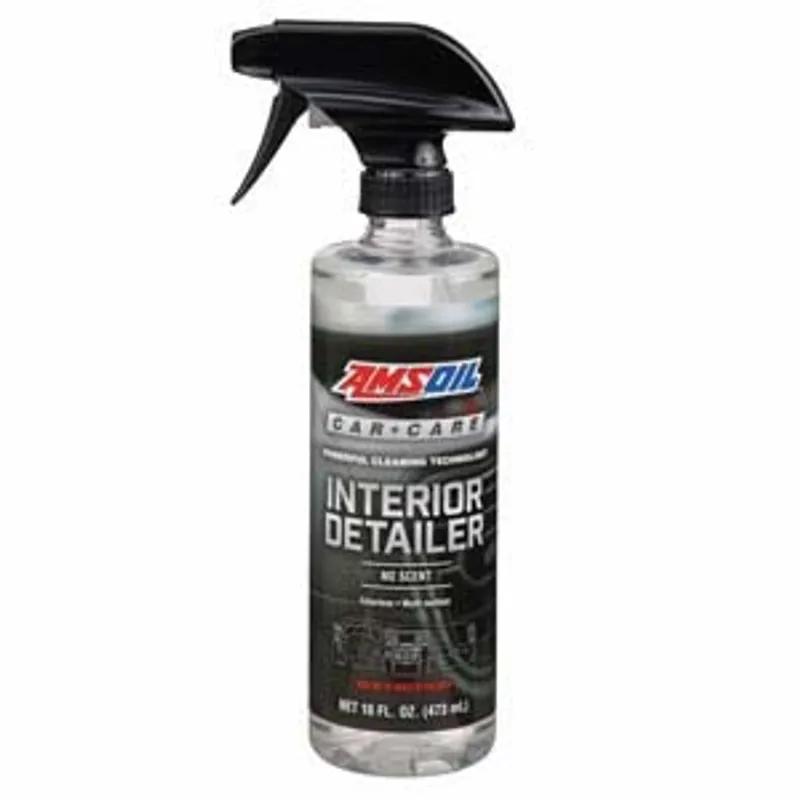
The product discussed here is AMSOIL Interior Detailer; the rest of this article walks through the materials map of a modern interior and what damages each surface.
A modern car interior is one of the most chemically diverse environments on the vehicle. Inside a single arm’s reach you can have soft-touch polyurethane coatings, plasticized PVC, polycarbonate touchscreens with fluoropolymer oleophobic top coats, anodized aluminum trim, chrome-effect plating, and pigmented coated leather. Each material has different chemical tolerances. Each one can be ruined by the wrong solvent.
This is the article most consumers need and few read. It walks through what those materials actually are, what damages them, and what an interior detailer formulator has to do to clean all of them without breaking any of them. It is part of a four-article series on car care chemistry; the hub article covers the broader formulation picture.
The materials map of a modern interior
Six material classes account for most of the interior surface area in a current-model passenger vehicle:
- Soft-touch polyurethane (PU) coatings. Sprayed onto rigid plastic substrates to give the dash and door cards their characteristic warm, slightly rubbery feel. Sensitive to high-VOC solvents, aromatic hydrocarbons, and prolonged UV.
- Plasticized PVC. Vinyl on door cards, console wraps, and some seat materials. Plasticizers (commonly DINP or non-phthalate alternatives in current production) maintain flexibility but volatilize slowly. ASTM D2240 hardness drift is a common indicator of plasticizer loss.
- Polycarbonate or chemically strengthened glass touchscreens with oleophobic coatings. Modern displays use a fluoropolymer top coat that gives the screen its smooth feel and lipophobic (“oil-repelling”) behavior. Corning publishes Gorilla Glass technical briefs on cleaning compatibility; major device OEMs publish display-cleaning guidance directly.
- Coated automotive leather. Pigmented and topcoated. Chemically closer to a coated plastic than to traditional leather.
- Anodized aluminum trim. Surface-converted aluminum with an oxide layer. Sensitive to strongly acidic and strongly alkaline cleaners.
- Chrome-effect plating, often vacuum-metallized plastic. Thin metal layer over plastic. Easily scratched mechanically; sensitive to abrasive cleaners and stronger solvents.
A detailer that is “safe for interiors” must be safe for every one of these.
What damages each material
The damage modes are well-documented:
- Soft-touch PU: solvent attack from acetone, MEK, aromatic hydrocarbons, or high-VOC alcohol cleaners. Prolonged exposure leads to surface tackiness and color shift. Hardness measured by ASTM D2240 (Shore A or D) is a useful tracking metric.
- Plasticized PVC: plasticizer migration to the surface and into vapor phase, accelerated by heat and certain solvents. Visible as windshield haze and as surface dryness on the vinyl itself. Peer-reviewed literature on phthalate migration (in Polymer Degradation and Stability and Journal of Vinyl and Additive Technology) covers the kinetics.
- Touchscreen oleophobic coatings: degradation by ammonia (glass cleaners), isopropyl alcohol above ~70%, and abrasive wiping. Once degraded, the screen feels grippy, fingerprints become more visible, and cleaning becomes harder.
- Coated leather: cracking from drying solvents and high-pH cleaners. Topcoat dulling from abrasive wiping.
- Anodized aluminum: etching at pH below ~4 or above ~10. The anodic oxide layer is chemistry-tolerant but not unlimited.
- Chrome-effect plating: scratching from abrasives, dulling from solvents that penetrate the thin metallization.
A single product cannot use anything aggressive enough to damage one of these materials, because that aggressive chemistry will be applied to all of them.
The “low residue” requirement
The phrase “low residue” gets used loosely. In an interior context it means three things together:
- The detergent system rinses cleanly without a wipe-and-rinse cycle. Interior cleaning is wipe-only — there is no rinse step. Any surfactant left on the surface is permanent until the next cleaning.
- The surfactant package does not leave a streak or sheen. Surfactant residues are visible on dark plastic and on glass. Formulation has to choose surfactants with minimal residue on dry-down.
- The carrier system flashes off cleanly. Water-based carriers leave only what is not water; solvent-based carriers leave only what is not solvent. The non-volatile fraction of the formula dictates the residue.
Achieving low residue while maintaining cleaning power on fingerprints, sebum oils, and dust requires careful surfactant selection. Too aggressive and the formula attacks soft-touch PU; too mild and the formula leaves fingerprints behind.
Antistatic chemistry: why it matters
Plastic interiors charge electrostatically through triboelectric contact — clothing rubbing against seats and door panels, microfiber wiping against dash surfaces. The resulting surface charge attracts airborne dust and lint. The dust film returns within hours of cleaning if the surface remains charged.
Antistatic agents address the cause, not the symptom. Two chemistries are common:
- Quaternary ammonium compounds. Cationic surfactants that deposit a thin conductive film. Effective but can interfere with anionic cleaning surfactants in the same formula, requiring careful balancing.
- Amphoteric and ethoxylated nonionic antistats. Compatible with mainstream cleaning surfactant systems. The dominant choice in modern multi-surface interior cleaners.
The standard reference for antistatic surface resistivity targets is IEC 61340-5-1. A surface in the 10^9 to 10^11 Ω/sq range is “static dissipative” and meaningfully reduces dust attraction; surfaces above 10^12 Ω/sq are insulators and accumulate charge.
A working interior detailer with proper antistatic chemistry leaves the surface visibly cleaner over the next several days than a comparable product without it. The longer-cleanliness benefit is the antistat working.
Touchscreens and oleophobic coatings
This deserves its own treatment because it is the most-damaged surface in the cabin.
Modern touchscreens — automotive infotainment, instrument cluster displays, head-up display covers — use a fluoropolymer oleophobic coating on top of the chemically strengthened glass or polycarbonate substrate. The coating is what makes the screen feel smooth and what causes water and oil to bead. It wears mechanically with use; it degrades chemically with the wrong cleaners.
Manufacturer guidance is consistent across the industry:
- Corning’s Gorilla Glass technical documentation specifies that ammonia-based glass cleaners and isopropyl alcohol degrade the oleophobic coating.
- Major consumer device manufacturers (Apple’s display-cleaning guidance, for example, is publicly published) recommend a soft, lint-free, slightly damp cloth and avoidance of solvents.
For automotive touchscreens, the practical implication is that the cabin should not be cleaned with the same product used on the windshield. A near-neutral, low-residue interior detailer with a touchscreen-safe formulation does not damage the oleophobic layer; an ammonia glass cleaner will, over enough applications.
Volatile organic compounds and indoor air
Cars sit in the sun. Interior cleaners that leave behind solvent residue contribute to off-gassing in a hot cabin. The CARB Consumer Products Regulation (in California) and EPA Method 24 set the framework for VOC measurement in cleaning products. An interior cleaner formulated for low VOC is also formulated for low cabin off-gassing.
This is one of the cleaner cases where the regulatory standard and the consumer benefit align. Lower VOC means less haze on the windshield, less smell, less long-term residue on cabin surfaces.
What an engineered interior detailer looks like
A working interior detailer formulated against the constraints described above will typically include:
- A near-neutral pH (around 7) to be safe across all interior materials.
- A nonionic and amphoteric surfactant blend chosen for low residue and broad material compatibility.
- An ethoxylated or amphoteric antistatic agent.
- A water-based carrier with low or zero added solvent.
- A trace conditioner package — typically a low-MW emollient — to maintain a slightly soft touch on plastic without creating a glossy sheen.
- A preservative system to maintain shelf stability without high-VOC content.
Conspicuously absent from a properly engineered interior detailer: ammonia, isopropyl alcohol, glycol ethers, aromatic solvents, silicone oils at gloss-creating concentrations, and abrasives.
AMSOIL Interior Detailer is built on this category of chemistry — low-residue, near-neutral, with antistatic agents to extend cleanliness between applications.
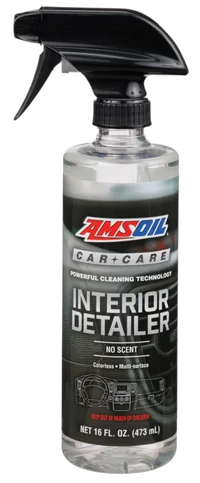
AMSOIL Interior Detailer - Scent Free
Product Code: IDNCN-EA
Join the Preferred Customer program to save approximately 25% off the retail price
National Synthetics is an authorized AMSOIL dealer. Links earn us a commission at no extra cost to you. Full disclosure
A workable interior cleaning sequence
The chemistry implies an order of operations:
- Vacuum first. Remove loose dust, grit, and debris before any liquid touches the surface. Dust dragged across plastic by a microfiber is the dominant source of micro-scratches in an interior.
- Spray detailer onto the microfiber, not directly onto the surface. Avoids overspray onto adjacent materials and onto the touchscreen.
- Wipe in straight lines, not circles. Reduces the visibility of any residual marks and is gentler on coated surfaces.
- Use a separate, dedicated, high-GSM microfiber for touchscreens. Keep the screen towel away from dashboard wax or trim dressing residue.
- Finish with a clean, dry second pass on glossy surfaces. Eliminates streaking from any local over-application.
- Skip glossy dressings on the dash. They migrate to the windshield over time. A subtle, satin finish is the durable choice.
Where to go from here
The chemistry of the wash that handles the exterior between detail sessions is in How pH-Balanced Car Shampoo Protects Paint and Coatings. The chemistry of paint protection is in SiO2 Ceramic Spray Coatings Explained. The companion article on tire and trim chemistry covers UV chemistry on rubber and plastic. The hub article ties them together.
Frequently Asked Questions
Can I use Windex or rubbing alcohol on my touchscreen?
No. Both ammonia (in glass cleaners) and isopropyl alcohol degrade the fluoropolymer oleophobic coating that gives modern displays their smooth feel and resistance to fingerprints. Display manufacturers including Corning (Gorilla Glass) and major device OEMs publish guidance against ammonia, alcohol, and abrasive cleaners. Use a low-residue, pH-neutral cleaner or a slightly damp microfiber.
Why does my dashboard leave a film on the inside of my windshield?
Plasticizers in the dashboard PVC volatilize over time, especially in heat. They condense on the cooler windshield as a hazy film. Glossy dressings on dashes can accelerate this by adding additional volatile components. A low-residue, low-VOC interior cleaner does not contribute to the haze; a heavy silicone dressing on the dash will.
Do antistatic agents really reduce dust?
Yes, when properly formulated. Antistatic chemistry adds a thin conductive surface layer that drains static charge to a more neutral state, reducing the electrostatic attraction that pulls airborne dust to plastic surfaces. The IEC 61340-5-1 standard specifies surface resistivity targets for antistatic materials.
Are multi-surface interior detailers safe for leather?
It depends on the formulation. Coated automotive leather is, in modern vehicles, almost always pigmented and topcoated — chemically closer to a coated plastic than to traditional leather. A low-residue, near-neutral cleaner designed for multi-surface interior use is generally safe. For aniline or semi-aniline leather, dedicated leather chemistry is preferable.
What is the right microfiber for cleaning a car interior?
For touchscreens, use a high-GSM (300+), tightly woven microfiber with no exposed edges. For dashboards and trim, lower GSM (200–300) is fine. Avoid the rough side of dual-pile microfibers on screens. Clean towels matter more than expensive ones — replace and wash them regularly.
References
- Corning Gorilla Glass technical briefs on display cleaning compatibility.
- Major consumer device OEM display-cleaning guidance (Apple, Samsung, manufacturer-published).
- ASTM D2240: Standard Test Method for Rubber Property — Durometer Hardness.
- IEC 61340-5-1: Electrostatics — Protection of Electronic Devices from Electrostatic Phenomena.
- Journal of Vinyl and Additive Technology and Polymer Degradation and Stability (Wiley / Elsevier), peer-reviewed literature on plasticizer migration in PVC.
- CARB Consumer Products Regulation (California Code of Regulations, Title 17).
- EPA Method 24: Determination of Volatile Matter Content of Surface Coatings.
National Synthetics is operated by an Independent AMSOIL Dealer. Outbound product links use a dealer reference parameter; the technical content above is independent of that.

Protect Your Engine with AMSOIL
Experience the difference premium synthetic lubricants make. Shop with confidence through your authorized AMSOIL dealer.
Browse AMSOIL Products