

How to Choose Motorcycle Oil: Viscosity, JASO MA Rating and Riding Conditions

Quick Answer
Use the viscosity your owner’s manual specifies, and if your bike has a wet clutch, an oil with the JASO MA or MA2 rating it calls for.
Then adjust your drain interval, not just your viscosity, for how you actually ride.
Whether you ride a V-twin cruiser, an adventure bike, a dual-sport, a dirt bike or a metric street bike, the oil question comes down to the same three decisions. Get them right and the rest is detail.
- What viscosity does the motorcycle manufacturer specify?
- Does the bike share its oil with the gearbox and a wet clutch?
- How hard, how hot and how dusty is your riding?
The answer is almost never “run the thickest oil you can find.”
Step 1: Start With the Viscosity in Your Manual
Viscosity is resistance to flow. Cold oil is thick and hot oil is thin. A multigrade such as 10W-40 has two parts. The first number, with the W, describes cold-temperature behavior. The second number is the viscosity grade at operating temperature, which is measured at 100°C (212°F). For a full explanation, read understanding oil viscosity.
A higher second number means the oil stays thicker when hot. That can help hold an oil film under load. It also increases fluid friction, and it may not suit every engine. Bearing clearances, oil-pump design and the cooling system were engineered around a specific range. The goal is the correct oil film thickness at real operating temperature, which is what your manual specifies.
Step 2: Check Whether Your Bike Has a Wet Clutch
Many motorcycles use a wet clutch: clutch plates that run in the same oil that lubricates the engine and gearbox. That is the main reason motorcycle oil selection is different from car oil selection. The oil has to do three jobs at once:
- Lubricate the engine.
- Lubricate the gearbox.
- Let the clutch engage cleanly without slipping.
Gear teeth also put the oil under high pressure and mechanical shear, which can reduce its viscosity. AMSOIL’s data sheet for its Synthetic Motorcycle Oil says it is shear stable to maintain viscosity in wet-clutch motorcycles that use the same oil for the engine and transmission. For how the clutch works and why the oil matters to it, see how to protect a motorcycle wet clutch.
What JASO MA, MA1, MA2 and MB mean
The JASO T903 standard classifies four-stroke motorcycle oils by clutch friction performance.
| JASO category | Practical meaning |
|---|---|
| MA | Wet-clutch motorcycle oil category |
| MA1 | Lower-friction portion of the MA range |
| MA2 | Higher-friction portion of the MA range |
| MB | Lowest-friction category. Generally not the right choice for wet-clutch bikes that call for MA |
The safe rule for dirt bikes, adventure bikes, dual-sports and metric bikes with a shared sump: use the viscosity your manual lists and an oil that carries the JASO MA or MA2 rating it requires. AMSOIL lists JASO MA/MA2 among the specifications for its Synthetic Motorcycle Oil in the 10W-30, 10W-40, 5W-40, 10W-50 and 15W-50 grades.
Why car oil can be the wrong choice
Some passenger-car oils carry friction modifiers to improve fuel economy. AMSOIL notes that these can reduce the friction in the clutch pack and cause excessive slippage. AMSOIL Synthetic Motorcycle Oil is formulated without friction modifiers for positive clutch engagement, smooth, precise shifting and long clutch life. Unless your manual says a car oil is acceptable, use a motorcycle oil.
Step 3: Match the Oil to How You Ride
The manual interval is written for moderate use. These conditions put more stress on oil:
- Stop-and-go traffic, long idling and slow technical riding. Air-cooled engines in particular lose airflow at low speed. Heat is one condition among these, not the only one.
- High-rpm riding. AMSOIL notes that high-rpm operation and gear shifts introduce air that can make some oils foam, and its Synthetic Motorcycle Oil contains anti-foam technology to help prevent that.
- Off-road and dusty riding. Dust that gets past the air filter ends up in the oil.
- Hills, loads and passengers. Higher load means more heat and more clutch work.
- Long storage between rides. AMSOIL notes that moisture can accumulate in an engine that is not ridden regularly, and its Synthetic Motorcycle Oil contains rust and corrosion inhibitors for that situation.
The data sheet for AMSOIL Synthetic Motorcycle Oil describes it as thermally stable to maintain viscosity in high-heat conditions, with oxidation inhibitors that inhibit sludge formation and help prevent clutch-plate glazing.
Common Motorcycle Oil Grades
There is no universal viscosity. Your owner’s manual is the authority. This is how the common grades usually line up.
10W-40
One of the most widely specified motorcycle viscosities, found on many metric street bikes, adventure bikes, dual-sports and smaller engines. If your manual calls for 10W-40, this is your grade.
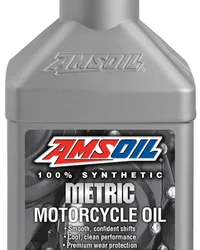
AMSOIL 100% Synthetic Metric Motorcycle Oil 10W-40
Product Code: MCFQT-EA
Join the Preferred Customer program to save approximately 25% off the retail price
10W-50 and 15W-50
Both keep a higher high-temperature grade than a 40-weight. Use them only where your manual allows or specifies them. AMSOIL offers 15W-50 in its metric motorcycle line and 10W-50 in both its metric and dirt bike lines.
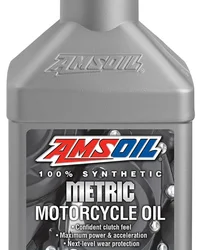
AMSOIL 100% Synthetic Metric Motorcycle Oil 15W-50
Product Code: MFFQT-EA
Join the Preferred Customer program to save approximately 25% off the retail price
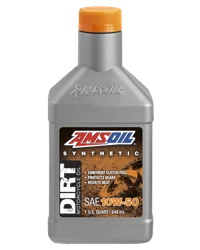
AMSOIL 10W-50 Synthetic Dirt Bike Oil
Product Code: DB50QT-EA
Join the Preferred Customer program to save approximately 25% off the retail price
20W-50
A common viscosity for V-twins and many air-cooled engines, where manufacturers specify it. Do not put 20W-50 in a modern liquid-cooled single, twin or inline engine unless the manual calls for it. If you ride a Harley or another V-twin, read should I use one oil in all three holes, and see AMSOIL Synthetic Motorcycle Oil vs. Harley-Davidson SYN3.
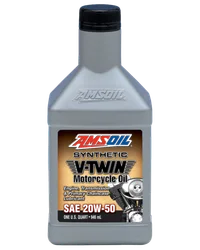
AMSOIL 20W-50 Synthetic V-Twin Motorcycle Oil
Product Code: MCVQT-EA
Join the Preferred Customer program to save approximately 25% off the retail price
AMSOIL Synthetic Motorcycle Oil: published properties
These are typical values from the AMSOIL data sheet for its Synthetic Motorcycle Oil (G3348, 8/26). HTHS is high-temperature/high-shear viscosity at 150°C.
| Property | 10W-30 (MCT) | 10W-40 (MCF) | 5W-40 (MMF) | 10W-50 (MSR) | 15W-50 (MFF) |
|---|---|---|---|---|---|
| Kinematic viscosity at 100°C, cSt | 11.6 | 14.4 | 14.6 | 17.5 | 18.9 |
| HTHS at 150°C, cP | 3.8 | 4.4 | 4.5 | 5.5 | 5.9 |
| Viscosity index | 166 | 169 | 181 | 177 | 170 |
| Pour point, °C (°F) | -48 (-54) | -48 (-54) | -48 (-54) | -40 (-40) | -39 (-38) |
| Noack volatility, % weight loss | 5.8 | 6.0 | 8.7 | 7.4 | 6.2 |
Drain Intervals
Follow your owner’s manual first. For AMSOIL Synthetic Motorcycle Oil, the data sheet says you can use it with an AMSOIL Oil Filter for up to twice the motorcycle manufacturer-recommended oil drain interval or one year, whichever comes first. With any other oil filter, change the oil and filter at the recommended intervals. Extended drain intervals are not recommended in racing or modified engines.
Dirt bikes and off-road bikes often run on a small sump, so time in the saddle and conditions matter as much as mileage. If your riding is hard on oil, shorten the interval. Used-oil analysis is the most accurate way to know what your oil is doing.
Protect the Air Filter, Too
A good oil cannot save an engine that is ingesting dust. Keep the air filter clean, make sure the airbox is sealed, check the intake boots and clamps, and change the oil sooner after dusty rides.
A Simple Way to Choose
- Read the manual. Find the allowed viscosity and the required specifications.
- Confirm the clutch type. If the bike has a wet clutch sharing the engine oil, use an oil with the JASO MA or MA2 rating it requires.
- Pick the viscosity the manual allows. Do not go thicker unless the manual permits it.
- Match the interval to your riding. Shorten it for dust, heavy load, racing or hard off-road use.
- Watch the bike. Notchy shifts, changed clutch feel, a falling oil level or a burnt smell all tell you the oil is working hard.
For decoding manual specifications on any vehicle, see how to read your owner’s manual oil specification. For a seasonal checklist, see how to prepare your motorcycle for summer riding.
Get the right oil for your bike.
Send us your year, make, model and how you ride, and we will point you to the AMSOIL product that fits. Preferred Customers get AMSOIL’s Preferred Customer program benefits on every order.
Already know you want to save on every order? Become a Preferred Customer.
Frequently Asked Questions
Can I use car engine oil in my motorcycle if the viscosity matches?
Only if your owner's manual says so. Most motorcycles share one oil between the engine, the gearbox and a wet clutch. AMSOIL notes that friction modifiers, added to some passenger-car oils to improve fuel economy, can lower the friction in the clutch pack and cause excessive slippage. Use an oil that carries the JASO rating and viscosity your manual calls for.
What does JASO MA mean and why does it matter?
JASO T903 classifies four-stroke motorcycle oils by wet-clutch friction performance into MA, MA1, MA2 and MB. MA and its two sub-categories are the ones wet-clutch motorcycles that call for MA need. MB is the lowest-friction category and generally is not appropriate for those bikes. If your manual calls for JASO MA, do not substitute an MB oil.
Should I go to a thicker oil because it is hot outside?
Not automatically. Your engine's bearing clearances, oil pump and cooling system were designed around a specific viscosity range. Move to a thicker grade only if your owner's manual permits it, or if the manual already specifies it for your bike, such as 20W-50 for many V-twins. Heavier oil than the design calls for can increase fluid friction and operating temperature.
How often should I change my motorcycle oil?
Start with your owner's manual. For AMSOIL Synthetic Motorcycle Oil, the data sheet allows up to twice the motorcycle manufacturer's recommended drain interval or one year, whichever comes first, when you use an AMSOIL Oil Filter. It does not recommend extended drain intervals in racing or modified engines. If your riding is hard on oil, such as dusty trails, lots of clutch slip or repeated hard laps, use a shorter interval and consider used-oil analysis.
Does my dirt bike or dual-sport share its oil with the clutch?
Most dirt bikes, dual-sports and adventure bikes do: the engine, gearbox and wet clutch run in the same oil. That is why they need an oil with the right friction properties for a wet clutch. A few models, including some KTM and Husqvarna four-strokes, use a separate gearbox sump. Your owner's manual shows which layout your bike has.
Is synthetic motorcycle oil worth it?
AMSOIL's data sheet for its Synthetic Motorcycle Oil describes 100% synthetic base oils and advanced additives meant for motorcycles operating at extreme temperatures, with a shear-stable formula that maintains viscosity in wet-clutch transmissions. Synthetic oil does not replace correct viscosity selection, a clean air filter or regular drain intervals. It adds margin on top of doing those right.
Can one oil cover a Harley engine, transmission and primary?
On most Harley-Davidson Softail, Touring, Dyna and Sportster models these are three separate compartments. Some riders use one V-twin motorcycle oil in all three and some prefer a dedicated fluid for each. Check your owner's manual and read our full guide on using one oil in all three holes before you decide.
References
- AMSOIL INC. — AMSOIL 100% Synthetic Motorcycle Oil Data Sheet, G3348 8/26 (typical technical properties, JASO MA/MA2 and API specifications, shear stability, friction-modifier-free formulation, anti-foam, rust protection, service life). amsoilcontent.com.
- AMSOIL INC. — Inside Track blog, “How to Protect a Motorcycle Wet Clutch” (friction modifiers and clutch slippage); see our wet clutch guide.
- JALOS — JASO T903 motorcycle four-cycle engine oil standard, implementation guidance (PDF) (MA, MA1, MA2 and MB categories).

Protect Your Engine with AMSOIL
Experience the difference premium synthetic lubricants make. Shop with confidence through your authorized AMSOIL dealer.
Browse AMSOIL Products