
GM's 6.2L L87 Recall Fix Is Under Federal Investigation: What Owners Need to Know Now
When GM recalled nearly 600,000 trucks and SUVs over failing 6.2L L87 V8s last year, the remedy came in two flavors: engines that failed inspection got replaced, and engines that passed got a switch from 0W-20 to 0W-40 oil, a new oil cap, and a handshake. We covered the whole saga — and what the viscosity change actually means — in our original L87 recall deep-dive.
Now the federal government wants to know whether either fix actually worked.
On January 16, 2026, NHTSA’s Office of Defects Investigation opened Recall Query RQ26001 — a formal investigation into the adequacy of the remedy for Recall 25V-274. The trigger: 36 owner complaints of catastrophic engine failure in trucks that had already received the recall fix. Not some of them. All 36. And the complaints span both remedy paths — engines that got the 0W-40 oil change and engines that were completely replaced.
If you own a 2021–2024 Silverado 1500, Sierra 1500, Tahoe, Suburban, Yukon, or Escalade with the 6.2, here’s what this means for you.
What is NHTSA Recall Query RQ26001?
A Recall Query is NHTSA’s formal mechanism for investigating whether a manufacturer’s recall fix actually solves the problem. It’s not a new recall — yet. It’s the government auditing GM’s homework, with an estimated population of 597,571 vehicles on the line.
The original recall, 25V-274, addressed supplier-related manufacturing defects in the L87’s connecting rods and crankshafts — defects that could cause sudden engine seizure and total loss of power at speed. GM’s remedy logic was: inspect the engine; replace it if it shows signs of the defect; if it passes, switch it to 0W-40 full synthetic for life, on the theory that a thicker oil film would help protect internal components with marginal tolerances or surface imperfections.
RQ26001 exists because failures kept coming after the remedy. NHTSA’s filing states the complaints “allege failures of both remedies” — post-oil-change engines failing, and post-replacement engines failing. Owner reports include a 2026 Yukon Denali Ultimate seizing at 1,600 miles.
And RQ26001 isn’t operating alone. It sits alongside an ongoing NHTSA Engineering Analysis into hundreds of L87 failures in vehicles outside the original recall population, plus a consolidated class-action lawsuit in which a federal judge has appointed interim counsel — a suit alleging the recall has caused widespread confusion and that GM’s fix may not prevent failure.
Does this mean the 0W-40 oil fix doesn’t work?
Not proven — but the question is now officially open, and the honest answer has always been more nuanced than GM’s messaging suggested.
Here’s the engineering reality we laid out in the original article, which holds up well under this news: a viscosity increase from 0W-20 to 0W-40 thickens the hydrodynamic oil film between the crank journals and bearings. For an engine with marginal machining — slightly rough journal finishes, tolerances at the edge of spec — that extra film thickness genuinely adds protective margin. That’s real tribology, and it’s why GM’s remedy wasn’t crazy.
But oil film thickness cannot fix:
- An out-of-spec bearing that’s already seeing metal-to-metal contact
- An out-of-spec crankshaft journal with a finish rough enough to cut through any reasonable film
- Casting or machining debris already circulating in, or embedded in, the engine
For those engines, thicker oil doesn’t prevent the failure — it delays it. The 36 post-remedy failures suggest at least some engines that “passed” GM’s inspection were in that second category. Whether that’s an inspection-criteria problem, a defect-scope problem, or both, is exactly what RQ26001 is tasked with finding out.
There’s a second uncomfortable possibility raised by the failed replacement engines: if new and remanufactured engines are also failing, then the defect may not be fully confined to the original supplier batch GM identified. That’s the scenario that turns a recall query into an expanded recall.
What should L87 owners do right now?
Five things — and none of them is “panic.”
1. Get the recall done anyway if you haven’t. An open RQ doesn’t suspend the recall. The 0W-40 switch or replacement remains the official remedy, it’s free, and skipping it only weakens your position if things go wrong later. Whether the remedy is sufficient is NHTSA’s fight; having it documented is yours.
2. Document like a litigator. Every oil change with receipts showing the oil used, every noise complaint, every dealer visit — dated and saved. With a class action live and NHTSA questioning the remedy, owners with clean paper trails will be in the strongest position for buybacks, reimbursements, or lemon-law claims. Loss of resale value is already a core owner grievance; documentation is how you protect against it.
3. Take symptoms seriously and report them twice. Knocking, ticking under load, metal flakes in the oil or filter, sudden stalls — dealer first, then file a Vehicle Owner Questionnaire at nhtsa.gov. Those 36 VOQs are literally what forced this investigation. The complaint database is the mechanism; use it.
4. If you got the oil remedy, treat the 0W-40 requirement as gospel — and choose that 0W-40 deliberately. Your engine now specs 0W-40 for life, per the new oil cap. Which brings us to the part we can actually help with.
5. Watch this space. RQ26001 will end one of three ways: closed with no action, closed with a remedy revision, or escalated into an expanded/superseding recall. We’ll update this article and the original guide as filings drop.
Which 0W-40 oil should recalled L87 trucks use?
One that holds its viscosity under exactly the conditions these engines fail in: sustained load, high heat, and time.
The entire logic of GM’s remedy is film protection. If the 0W-40 in your crankcase shears down toward a 30-weight after a few thousand hard miles — a real phenomenon in lesser formulations, where the polymer viscosity improvers physically break apart — you’ve quietly lost the margin the recall was supposed to give you. For an engine population under federal investigation for post-remedy failures, that’s not where you want to economize.
This is precisely the use case premium synthetics are built for. AMSOIL Signature Series 0W-40 (AZF) is formulated for shear stability and high-temperature film retention under sustained load — the towing, hauling, and hot-idle duty cycles these trucks actually live. It carries API SP and meets and exceeds GM’s dexos® R specification — the standard behind the remedy fill. Full test data and sizes are on our Signature Series 0W-40 page. (Worth knowing as you shop: the recall conversation happens against the backdrop of GM’s dexos R standard — we broke down what dexos R is and where AMSOIL stands in our dexos R explainer.)
Whatever brand ends up in your crankcase, two rules are non-negotiable for a remedied L87: never fall back to 0W-20, and shorten your intervals under severe service. An engine that GM itself decided needs extra film protection is not the engine to stretch oil changes on. Inspect the filter for metallic debris at every change — on this platform, glitter in the pleats is a dealer visit, not a shrug.
The remedy put 0W-40 on your oil cap. Make it count.
Your L87’s protective margin now lives or dies on how well that 0W-40 holds up between changes. Order Signature Series 0W-40 (AZF), or browse the full Signature Series lineup if you run other vehicles too.
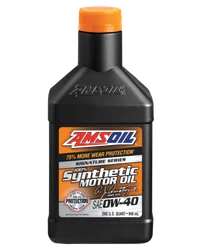
AMSOIL Signature Series 0W-40 100% Synthetic Motor Oil
Product Code: AZFQT-EA
Join the Preferred Customer program to save approximately 25% off the retail price
National Synthetics is an authorized AMSOIL dealer. Links earn us a commission at no extra cost to you. Full disclosure
Frequently asked questions
Is there a new GM 6.2L recall in 2026?
Not yet. RQ26001, opened January 16, 2026, is a federal investigation into whether the existing recall (25V-274) remedy is adequate — covering an estimated 597,571 vehicles. If NHTSA concludes the remedy failed, an expanded or superseding recall is a possible outcome. A separate Engineering Analysis into L87 failures outside the recall population is also ongoing.
My L87 already got the 0W-40 fix. Is my engine safe?
The 0W-40 remedy adds real protective film margin for engines with marginal tolerances, but NHTSA is investigating complaints that engines failed after receiving it. Keep running 0W-40 (a shear-stable premium synthetic such as AMSOIL Signature Series 0W-40 maximizes the intended protection), document all maintenance, and report any knocking, ticking, or metal-in-oil symptoms to your dealer and NHTSA immediately.
Engines replaced under the recall are failing too?
That's what the complaint data alleges — NHTSA's filing notes the 36 reports include failures of both remedies, replacements included. GM implemented supplier and manufacturing changes for remedy engines; whether those changes fully resolved the defect is part of what RQ26001 will determine.
Can I go back to 0W-20 in my recalled 6.2?
No. If your truck received the recall remedy, 0W-40 is the permanent factory specification, indicated on your new oil cap. Reverting to 0W-20 removes the protective margin the remedy exists to provide and could complicate warranty and legal standing.
Should I sell my L87 truck?
That's a personal financial call, but know the landscape: diminished resale value is a central complaint in the class action, and a truck with complete recall documentation and meticulous service records will always be worth more than one without. If you keep it: recall compliance, premium 0W-40, shortened severe-service intervals, and a paper trail.
Sources: NHTSA Recall Query RQ26001 (opened January 16, 2026) regarding Recall 25V-274; NHTSA Office of Defects Investigation filings; ongoing federal class-action proceedings.
This is a developing story. Bookmark this page — we’ll update it as NHTSA filings, GM responses, and court developments land. And if your L87 failed after the fix, file the VOQ at nhtsa.gov. It matters.
Disclaimer: This article is for informational purposes only. Always follow manufacturer recommendations and recall instructions. AMSOIL INC. is not affiliated with General Motors. All trademarks are property of their respective owners.

Protect Your Engine with AMSOIL
Experience the difference premium synthetic lubricants make. Shop with confidence through your authorized AMSOIL dealer.
Browse AMSOIL Products